
Something I have been thinking about and working on as an instructor at Sci-Tech for several years is exactly how to talk to kids effectively.
I used to think that the hard, important part of this was how to talk to a big group of kids. In particular, how to have a commanding “teacher voice” that would rise above the noise on the playground and make kids stop what they were doing and stand in straight lines, like I remember from when I was a kid. I’ve gotten better at that, but I’m still working on it.
What I’ve discovered is that, while the “teacher voice” is helpful, what’s actually important is the way I talk to kids to teach them one-on-one, or in interacting with groups of kids who are already engaged on the subject matter. That’s where the learning happens.
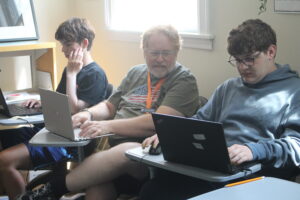 A powerful idea from the field of educational psychology is the Zone of Proximal Development. This is the idea that learning happens when doing activities that one can’t quite do on their own, but can do with some help or guidance from another person. As an instructor, a lot of what I am doing is getting kids right to the edge of what they can figure out on their own. Note that exactly where that edge is varies from learner to learner, and naturally moves as they learn.
For example, imagine a situation in computer programming where the way to get the computer to do what you want is to use a conditional, or as it’s written in the code, an if statement. When a kid asks for help, I might ask, “is there something we learned that you can use?” If they realize they need an if statement, we might be done. But if not, I’ll move closer to the “edge,” and ask, “can you think of a way to solve this with an if statement?” And if not: “How about an if statement that checks if the ball has moved off the screen?” And then: “I think you need to check the x value.” And if they still need help: “Why don’t we check if the x value is greater than 250?” And eventually: “so you type that as an x, then a greater-than sign, and then the number 250.” Some kids might need to hear: “greater-than is the symbol you get when you press shift-period on the keyboard.” And if they are struggling even with typing (not uncommon for our youngest campers): “Do you mind if I type so I can show you?”
The important thing is that some kids will understand after the first question I ask to prompt them, and figure the rest out on their own. Some kids will need me to guide them through a few steps. And, some need to be told exactly what to type. If you haven’t guessed: it takes patience (savlanut)–for an instructor (and for the camper!). Sometimes you will go through the steps above, get the kid to type (for example) “if x > 250:”, and then tell them “now you just have do the same thing with y and 200” and they look confused and you have have to go through all the steps again to get them to type “if y > 200:” two lines below. But, it’s how you respond in that moment that makes you a teacher.
Being a workshop instructor, then, means figuring out how to scale that: In what areas are kids at a similar enough level that I can teach them as a group? How do the counselors and I effectively manage our time when there are multiple kids who need individual help? How do we provide multiple learning opportunities in one room when kids are at different levels? After five years at Sci-Tech, I’ve gotten better at all of this–but like all good teachers, I’m also forever still learning!
Cantor Marc Stober
He/Him/His
Cantor Marc is a Senior Lead Instructor at Sci-Tech. Summer 2026 was his 5th year at camp. He is from Newton, MA. When not at camp, he serves as religious school director at Temple Beth Shalom in Melrose, MA; teaches introductory computer programming in the Digital Media program at Northeastern University; and makes Jewish music when he can. He loves learning and discovering more about how things work, both technological and regarding the human mind.